Until recently, when a business wanted to be found online, the goal was clear: rank on the first page of Google. Today, that picture is changing.
More and more users are no longer satisfied with a list of search results. They turn to ChatGPT, Gemini, Perplexity, and other AI platforms and ask direct questions such as:
Which service provider is recommended in my area?
Which company is considered a leader in this field?
Which product is best suited to my needs?
Where should I order this service?
Instead of browsing through ten different websites, users increasingly receive a summarized answer that may include recommendations, sources, businesses, and brands.
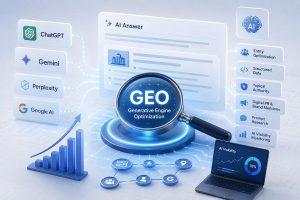
This is where GEO – Generative Engine Optimization comes into play: a process designed to increase a business’s visibility, authority, and chances of being mentioned in answers generated by AI-powered search engines and assistants.
But how does GEO actually work?
What Is GEO?
GEO focuses on optimizing a business’s digital presence for AI-powered search and answer engines.
While traditional SEO aims to help a specific page rank higher in search results, GEO takes a broader view.
It asks questions such as:
Does the AI system recognize the brand?
Does it understand what the business specializes in?
Are there enough online sources supporting its expertise?
Is the information about the business clear and consistent?
Is there strong content that AI systems can use when answering user questions?
The goal is not only for a page to rank, but for the business itself to become a clear, credible, and authoritative entity that can potentially be included in AI-generated answers.
GEO Is Not About Buying a Recommendation from ChatGPT
It is important to understand the difference.
Organic GEO is not about paying ChatGPT to recommend a specific company.
You cannot simply buy a statement such as:
“We recommend Company X.”
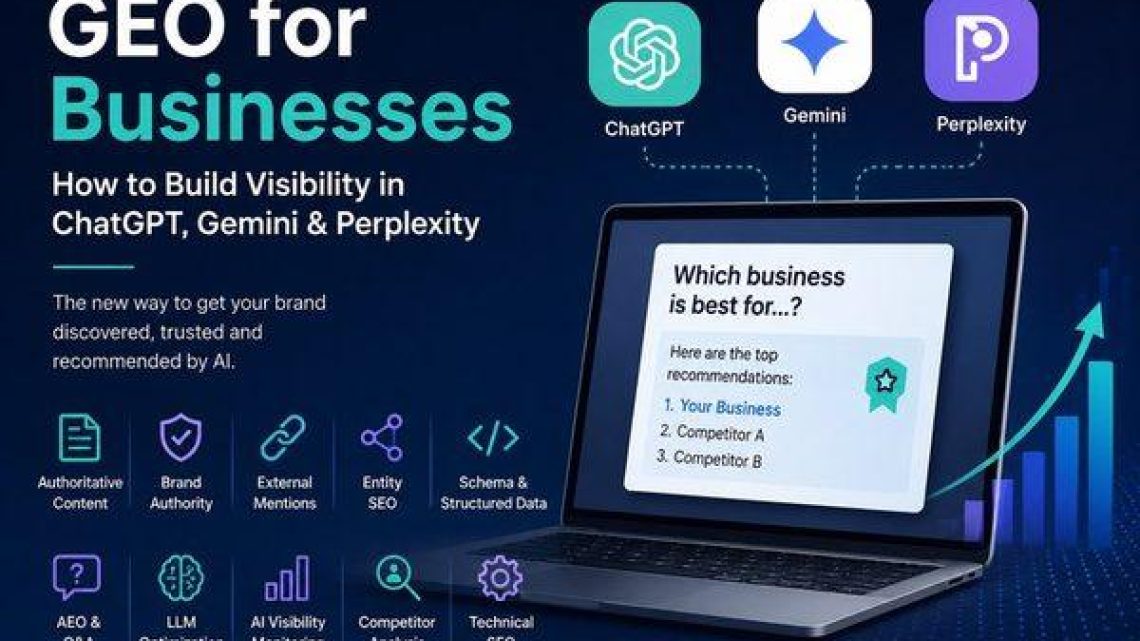
Instead, GEO focuses on building a strong ecosystem of digital signals around the brand: authoritative content, mentions, credibility, structured information, external references, technical SEO, and more.
When an AI-powered search engine looks for current information online, it attempts to identify relevant and credible sources that match the user’s question.
There is no reliable way to guarantee that a specific business will always appear first or be recommended. Visibility depends on a combination of relevance, authority, available information, context, and the way the AI system retrieves and interprets sources.
That is why GEO should not be viewed as a trick or a single technical adjustment. It is a long-term digital strategy.
1. Creating Authoritative Content
Content is one of the foundations of GEO.
AI systems need information in order to answer questions. The more useful, clear, detailed, and relevant content a website contains, the stronger the foundation it creates for search engines and AI systems to understand the business and its area of expertise.
This content can include:
- Professional guides
- In-depth articles
- Service pages
- Frequently asked questions
- Comparisons
- Case studies
- Expert explanations
- Data and research
- Content based on real-world experience
The goal is not to produce huge amounts of generic AI-generated text.
In fact, in an era where content can be created very quickly, original expertise, professional experience, examples, unique data, and useful insights become even more valuable.
High-quality content should provide users with information they cannot simply find repeated in exactly the same form across hundreds of other websites.
2. Building Brand Authority
A website can say almost anything about itself.
But when similar information appears across other trusted sources online, it creates a much stronger picture of the brand.
That is why GEO does not happen only on the business website.
Businesses need to strengthen the relationship between their brand name and the topics for which they want to be recognized.
If a company wants to become associated with a specific field of expertise, it should consistently build a digital presence around that field.
Articles, professional profiles, media mentions, interviews, reviews, external references, and backlinks can all contribute to building this authority.
3. Earning Mentions on External Websites
One important part of a GEO strategy is building visibility outside the properties controlled directly by the business.
These external sources can include:
Industry websites, news websites, professional directories, niche publications, PR articles, interviews, reviews, expert roundups, and other relevant sources.
Not every mention necessarily has to include a backlink.
The repeated association between a brand and a particular professional topic can help strengthen the digital relationship between the two.
In simple terms, the goal is to create a consistent online picture that says:
This is the business, this is what it specializes in, and these external sources support that association.
4. Entity SEO – Helping Search Engines Understand Who You Are
One of the most important concepts in modern search is the entity.
A company, person, product, organization, or location can all be treated as entities.
Entity SEO aims to create a clear relationship between:
Business name + services + people + industry + location + website + digital profiles
For example, if a business uses one name on its website, another variation in professional directories, and a third version on social media, it creates less consistency.
When the same identity, business information, services, and brand details appear consistently across the web, it becomes easier for search engines and AI systems to understand that all of these references relate to the same entity.
5. Schema and Structured Data
Schema is a layer of structured information added to a website’s code that helps search engines better understand what appears on a page.
Depending on the type of website, businesses may use structured data such as:
Organization, LocalBusiness, Person, Product, Article, and other relevant schema types.
Schema is not a magic button that automatically makes a business appear in ChatGPT.
However, it can be part of a strong technical foundation that clearly communicates who the business is and what information appears on each page.
6. AEO – Answering the Questions Customers Actually Ask
Alongside GEO, another important concept is AEO – Answer Engine Optimization.
Instead of focusing only on keywords such as:
“SEO company”
Businesses should also think about the full questions people are now asking:
How do I choose an SEO agency?
Who is recommended for promoting a business in ChatGPT?
How much does AI search optimization cost?
What is the difference between SEO and GEO?
How can I get ChatGPT to recognize my business?
Content built around real user questions makes it possible to provide direct and useful answers.
This format is highly relevant to conversational search and AI-powered answer engines.
7. Optimization for LLMs and AI Search Engines
In the world of GEO, simply adding a keyword to a headline and repeating it several times is not enough.
Information should be organized in a way that is easy to understand.
Clear headings, focused paragraphs, definitions, lists, comparisons, FAQs, facts, and examples make content easier to process for both users and systems analyzing the page.
Each important page should clearly answer basic questions such as:
Who is this about?
What is the topic?
What is the expertise?
Who is the service designed for?
What makes the business different?
The clearer the information, the less the search system has to infer what the website is actually about.
AI Search Optimization: How to Lead in the New Era of AIO, GEO & AEO
8. Monitoring AI Visibility
In traditional SEO, businesses are used to tracking rankings on Google.
With GEO, measurement needs to expand.
Businesses can monitor relevant commercial and professional questions and examine:
Does the brand appear in the answer?
In what context is it mentioned?
Which other brands appear?
Which sources are cited?
For which questions does the brand appear?
Where is it still missing?
Does visibility improve over time?
The goal is not to test one question once and declare success.
AI-generated answers can vary based on wording, context, available sources, current information, and changes to the underlying platforms.
For that reason, businesses should monitor a set of relevant prompts and broader visibility trends, rather than rely on a single screenshot.
9. Analyzing Competitor and Market Gaps
One of the most useful aspects of GEO is understanding why one brand is repeatedly mentioned for a certain topic while another is not.
If AI search engines consistently reference other companies or sources, businesses can investigate:
What type of content do they publish?
Where are they mentioned?
Which topics do they cover?
What information is missing from our own website?
Are there authority gaps?
Are there important questions we are not answering?
This turns AI visibility monitoring into a practical growth strategy.
10. Traditional SEO Still Matters
The rise of ChatGPT, Gemini, Perplexity, and other AI-powered search experiences does not mean traditional SEO is no longer relevant.
Quite the opposite.
A website that cannot be crawled properly, has weak internal structure, poor content, slow performance, indexing issues, or limited authority will face challenges in both traditional and AI-driven search environments.
Technical SEO, keyword research, website architecture, internal and external linking, content quality, indexing, and user experience are still essential.
The difference is that the goal has expanded.
Businesses should no longer ask only:
“What position do we rank in on Google?”
They should also ask:
“Is our brand visible in the world of AI-generated answers?”
SEO, AEO, and GEO Should Work Together
The right strategy is not to choose between SEO and GEO.
The strongest approach is to combine them.
SEO helps a website become accessible, relevant, technically strong, and visible in search engines.
AEO focuses on answering questions directly and structuring information for answer engines.
GEO looks at the broader presence of the brand within generative search environments and aims to increase the likelihood that the business becomes a recognized source or entity in AI-generated answers.
When these three layers work together, businesses build a digital strategy that is better aligned with the way people search for information today.
Yossi Levy Digital – A Leading Agency for AI Search and GEO
Effective GEO requires much more than simply knowing how to generate content with AI tools.
It requires an understanding of SEO, content strategy, digital authority, Entity SEO, AI search systems, user experience, data analysis, and digital marketing — and the ability to combine them into one coherent strategy.
Yossi Levy Digital is a leading digital marketing agency that combines extensive SEO experience with advanced expertise in AI-driven search, including GEO, AEO, and AI Search Optimization.
The approach is not to replace traditional SEO with a new trend, but to expand it for a reality in which customers increasingly search through ChatGPT, Gemini, Perplexity, and other AI-powered platforms.
The process can include research, content strategy, brand authority building, technical optimization, entity and structured data optimization, external mentions, question-based content development, and ongoing monitoring of AI visibility.
How Do You Start a GEO Process for a Business?
The first step is understanding the business’s current digital position.
What topics is the brand already associated with online?
What appears when people search for the business name?
Are there enough credible external sources?
Does the website clearly explain the company’s expertise?
What content is missing?
Which commercial questions are strategically important?
What do AI search engines currently show when users ask those questions?
Based on this information, it is possible to build a structured GEO strategy around three main goals:
Be understood. Be authoritative. Be visible.
Conclusion: Search Is Changing, and Digital Strategy Must Change With It
SEO is not disappearing, but the way people discover information is changing quickly.
Users no longer always type two keywords into Google and browse ten results. Increasingly, they ask a complete question and expect an AI system to perform a significant part of the research process for them.
For businesses, the implication is clear.
In the coming years, having a good website alone will not be enough. It will become increasingly important for search engines and AI systems to recognize the business, understand what it specializes in, and find enough credible digital signals to support its authority.
This is exactly where GEO becomes relevant.
By combining SEO, authoritative content, AEO, Entity SEO, structured data, external mentions, brand building, and AI visibility monitoring, businesses can build a digital presence that is better suited to the new search landscape.
And in a world where more and more customers ask ChatGPT, Gemini, and Perplexity who they should trust, businesses should no longer ask only:
“Are we ranking first on Google?”
They should also ask:
“Does AI know us well enough to include us in the answer?”